Blog
How to Select the Right BCI Battery Group Size for Your Vehicle?


Selecting the correct BCI battery group size ensures your vehicle starts reliably and powers all onboard electronics safely. BCI sizes standardize dimensions, terminal placement, and capacity for automotive batteries. Choosing the wrong size can cause poor fit, reduced performance, or damage. Redway Power offers insights to help identify the optimal battery size for your vehicle with precision.
What Is a BCI Battery Group Size?
BCI (Battery Council International) group sizes categorize batteries by physical dimensions, terminal positions, and type. Each size ensures compatibility with specific vehicles, providing proper fit and secure mounting. Knowing your vehicle’s required BCI group avoids installation issues.
How Does Vehicle Type Affect Battery Group Selection?
Different vehicles require varying capacities and dimensions. Compact cars often use smaller group sizes like 51 or 24, while trucks and SUVs need larger groups like 48, 65, or 49 for higher cold-cranking amps (CCA) and reserve capacity. Redway Power designs solutions accounting for vehicle type and electrical demand.
Why Is Cold Cranking Amps (CCA) Important in Battery Selection?
CCA measures a battery’s ability to start an engine in cold conditions. A battery with insufficient CCA may fail in low temperatures. BCI group selection often aligns with vehicles’ CCA requirements, ensuring reliability in extreme climates.
How Do Reserve Capacity and Amp-Hour Ratings Influence Choice?
Reserve capacity indicates how long a battery can power essential systems if the alternator fails. Amp-hour (Ah) rating shows energy storage. Larger vehicles typically need higher RC and Ah ratings, influencing the BCI group choice.
Where Can I Find My Vehicle’s Recommended Battery Group Size?
Check the owner’s manual, existing battery label, or manufacturer database. BCI group numbers are listed to ensure proper fit. Redway Power also provides guidance for compatible battery group sizes for aftermarket and OEM replacements.
How Do Terminal Positions Affect Installation?
BCI groups specify terminal layout—top post, side post, or combination. Incorrect positioning can prevent secure connection or cause wiring stress. Always match terminal type to vehicle requirements for safe installation.
Can I Use a Different BCI Group Size Than Recommended?
In some cases, slightly larger or smaller batteries may fit, but terminal orientation, CCA, and physical dimensions must align. Deviating from manufacturer recommendations risks fitment issues or insufficient power. Redway Power engineers recommend adhering to OEM specifications whenever possible.
What Are Common BCI Battery Group Numbers and Their Uses?
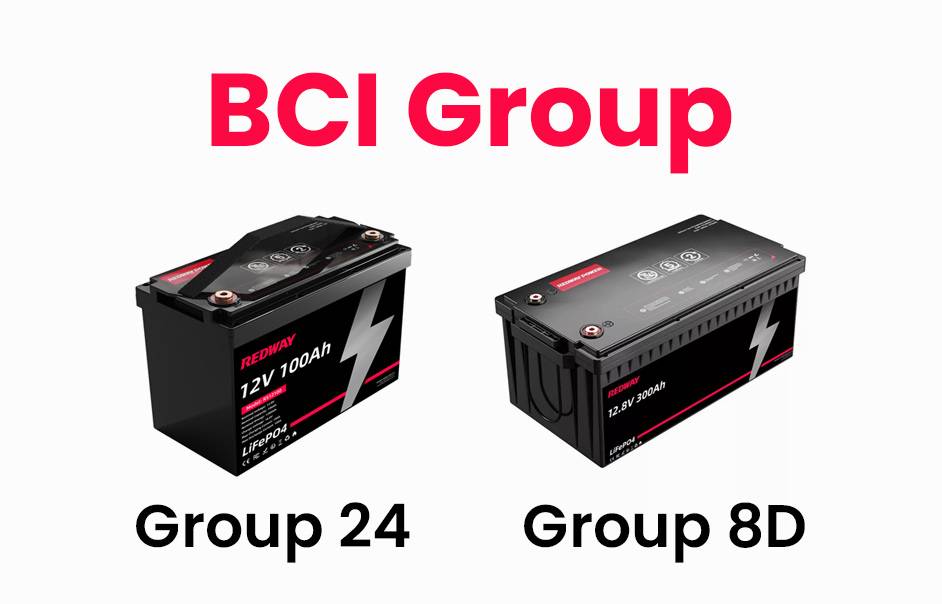
Common groups include 24, 24F, 27, 31, 48, 49, 65. Compact sedans often use 24/24F, trucks and SUVs 48/65, and marine applications may require 31 or 49. Each group matches specific vehicle needs for power, fit, and longevity.
How Do Maintenance Requirements Vary With BCI Group?
Maintenance-free batteries are prevalent in modern vehicles; however, some BCI group sizes still offer serviceable options for electrolyte checks. Knowing whether the battery is sealed or serviceable helps ensure proper long-term performance.
Chart title: Example BCI Group Sizes and Vehicle Applications
| BCI Group | Typical Vehicle Type | Common CCA | Terminal Type |
|---|---|---|---|
| 24 | Compact car, sedan | 550–650 | Top post |
| 24F | Mid-size sedan | 600–700 | Top post |
| 27 | Light truck, SUV | 650–750 | Top post |
| 31 | Truck, SUV, marine | 750–950 | Side/top post |
| 48 | Full-size truck, SUV | 700–900 | Top post |
| 49 | Marine, RV | 850–1000 | Top/side post |
| 65 | Heavy truck, SUV | 900–1100 | Top post |
What Safety Considerations Should Be Taken When Selecting a Battery?
Always ensure proper mounting, correct terminal orientation, and adequate ventilation. Using the wrong BCI group can lead to short circuits, electrolyte leaks, or damage. Redway Power integrates safety features and BMS technology for lithium replacements to mitigate risks.
How Do Battery Technologies Affect BCI Group Selection?
Lead-acid remains standard for most vehicles, but lithium-ion batteries are gaining popularity due to higher energy density, lighter weight, and longer lifespan. Redway Power produces OEM lithium packs compatible with standard BCI group sizes for enhanced performance.
Redway Power Expert Views
“Selecting the right BCI group is critical for both performance and safety,” says a Redway Power battery expert. “Even small deviations in terminal layout or CCA can compromise reliability. Our team ensures precise BCI compatibility while integrating advanced lithium technology for longer life and superior efficiency.”
Conclusion
Choosing the correct BCI battery group size involves understanding vehicle type, physical dimensions, CCA, reserve capacity, and terminal layout. Using manufacturer recommendations ensures safety, performance, and longevity. Redway Power provides expert guidance and high-quality lithium battery solutions compatible with standard BCI group sizes, ensuring reliable power for all vehicles.
FAQs
Can I use a larger battery than my recommended BCI group?
Only if it fits physically and meets CCA and terminal requirements; otherwise, risks exist.
Are BCI group numbers the same globally?
BCI is U.S.-based; some countries use different standards like EN or DIN.
How often should I check my battery’s health?
At least twice a year or before extreme temperature seasons.
Can lithium batteries replace lead-acid in any BCI group?
Yes, with proper BMS and voltage compatibility; Redway Power provides such solutions.
What happens if I install incorrect terminal orientation?
It may prevent proper connections, cause short circuits, or damage electronics.