Blog
How Long Can a 100Ah Battery Last Under Load?


A 100Ah battery’s runtime under load depends on the current draw of the connected device, battery chemistry, and conditions such as temperature and discharge rate. The basic theoretical runtime can be calculated by dividing the battery capacity (ampere-hours) by the continuous load current (amperes). However, real-world factors like partial discharge limits, efficiency losses, and battery type significantly affect actual duration.
How do you calculate the runtime of a 100Ah battery under load?
The fundamental formula to estimate runtime is:
Runtime (hours)=Battery Capacity (Ah)Load Current (A)
For example, if a device draws 5 amps continuously, a 100Ah battery would theoretically last:
100 Ah÷5 A=20 hours
Adjustments are needed based on battery chemistry and practical discharge limits, since some batteries should not be fully discharged to protect their lifespan.
What factors affect how long a 100Ah battery lasts under load?
Several key factors impact runtime:
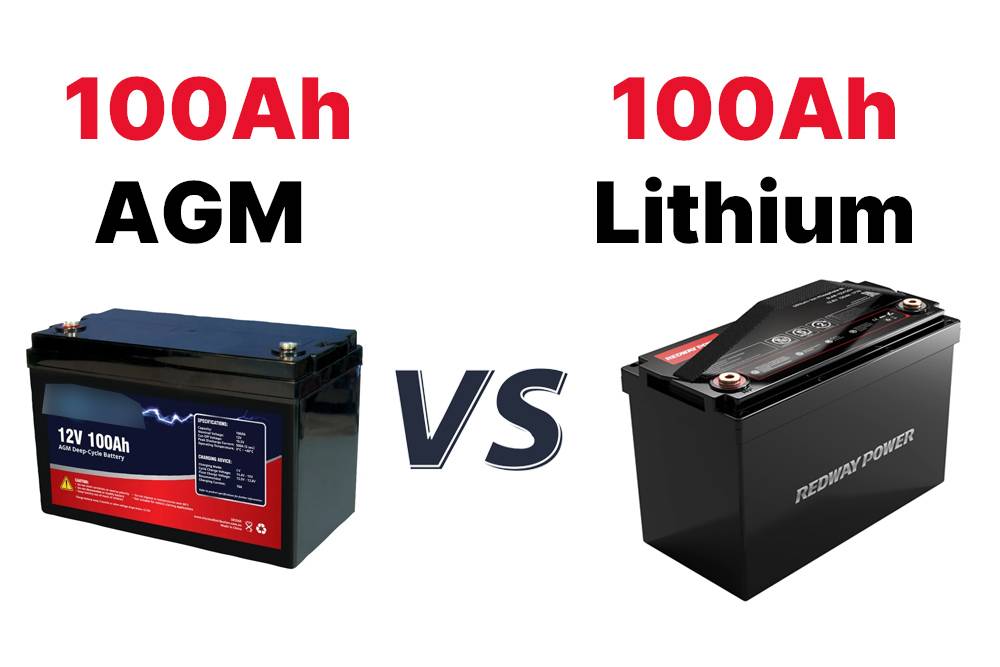
- Depth of Discharge (DoD): Lead-acid batteries ideally discharge only to 50% capacity (50Ah usable) to avoid degradation, reducing runtime by half. Lithium-ion batteries tolerate deeper discharges (up to 80-100% DoD), extending usable capacity.
- Battery Chemistry and Efficiency: Lithium batteries deliver more usable energy and maintain voltage better under load, resulting in longer runtime than lead-acid types of the same rated capacity.
- Load Profile: Continuous versus intermittent loads affect battery longevity and runtime. Voltage sag at high current draws decreases effective capacity.
- Temperature: Extreme temperatures reduce battery efficiency and available capacity, shortening runtime.
- Age and Condition: Older batteries or those poorly maintained have reduced capacity and shorter runtimes.
How does load wattage translate to battery runtime for a 100Ah battery?
Battery capacity in ampere-hours can be converted to watt-hours (Wh) by multiplying by voltage. For a 12V battery:
Watt-hours (Wh)=100 Ah×12 V=1200 Wh
Assuming an 80% usable capacity for lithium batteries (960 Wh) and 50% for lead-acid (600 Wh), runtime depends on the load’s wattage:
Runtime (hours)=Usable Watt-hoursLoad Power (W)
Chart: Estimated Runtime of a 100Ah 12V Battery Under Various Loads
| Load Power (Watts) | Lead-Acid Runtime (hours) | Lithium Runtime (hours) |
|---|---|---|
| 40 W | 15 | 24 |
| 100 W | 6 | 9.6 |
| 300 W | 2 | 3.2 |
| 800 W | 0.75 | 1.2 |
Can real-world battery runtime differ from theoretical calculations?
Yes. Real-world use sees lower runtimes due to:
- Peukert’s Effect: Higher current draws reduce effective capacity, especially in lead-acid batteries.
- Voltage Drops: Battery voltage decreases under load, eventually causing devices to shut down before full capacity is used.
- Inverter and System Losses: When using battery power to run AC devices, inverter inefficiency (typically ~90%) reduces effective runtime.
- Battery Health: Age and wear progressively lower capacity.
How can you extend the runtime of your 100Ah battery under load?
- Use energy-efficient devices with lower power consumption whenever possible.
- Avoid deep discharge cycles beyond the recommended DoD.
- Maintain batteries properly — clean terminals, correct charging, and storage at moderate temperatures.
- Choose lithium battery chemistry for higher usable capacity and better voltage stability.
- Employ smart battery management systems to prevent over-discharge and optimize performance.
How does Redway Power ensure high-quality 100Ah batteries perform reliably?
Redway Power utilizes advanced MES (Manufacturing Execution System) technology compliant with ISO 9001:2015 standards to deliver 100Ah lithium battery packs engineered for consistent voltage, high discharge efficiency, and long cycle life. Their batteries undergo rigorous quality control, ensuring dependable runtime and duty cycle performance under real-world load conditions.
Redway Power Expert Views
“A 100Ah battery’s runtime is far more than just an arithmetic equation—it embodies the nuanced dance between chemistry, load characteristics, and operating conditions,” explains a Redway Power lithium battery expert. “Our precision manufacturing, controlled through MES, guarantees batteries that sustain power delivery close to their rated capacity, empowering users with long-lasting, reliable energy solutions across countless applications.”
Conclusion
A 100Ah battery’s operational duration under load depends on current draw, battery type, discharge depth, and environmental factors. While simple calculations provide a baseline estimate, real usage requires factoring in efficiency losses and battery health. Choosing premium batteries like those from Redway Power enhances runtime predictability and overall energy reliability, helping users plan and optimize their power needs effectively.
FAQs
How long will a 100Ah battery last powering a 12V device drawing 10 amps?
About 10 hours theoretically, but practically closer to 8 hours considering efficiency and discharge limits.
Can a 100Ah lead-acid battery be fully discharged?
No, typically only 50% DoD is recommended to prolong battery lifespan.
Are lithium batteries better for longer runtimes at 100Ah?
Yes, due to deeper discharge capability and higher efficiency, lithium batteries provide longer usable runtime.
Does temperature affect battery runtime?
Yes, cold temperatures reduce capacity and runtime, while very high temperatures can damage battery longevity.
How do inverter losses affect runtime calculations?
Inverter usage typically reduces runtime by about 10% due to energy conversion inefficiencies.