Blog
How to Choose the Right 36V Forklift Battery for Crown Models


Choosing the right 36V forklift battery for Crown models directly impacts uptime, safety, and total cost of ownership. With warehouses under pressure to move faster and operate leaner, selecting a battery that matches voltage, capacity, and duty cycle is no longer optional but a performance-critical decision.
What Is the Current Industry Situation and Where Do the Pain Points Come From?
The global forklift market exceeded 2.1 million units shipped annually, with electric forklifts accounting for over 70% of new purchases in North America and Europe. According to the Material Handling Industry of America, battery-related downtime contributes to nearly 20% of unexpected equipment stoppages in electric fleets.
Warehouse electrification has increased average forklift utilization from 6 hours per shift to over 10 hours per day in multi-shift operations. This higher duty cycle exposes the limits of traditional 36V lead-acid batteries used in many Crown models.
Safety and labor costs are another pressure point. OSHA reports that battery handling and charging accidents remain a frequent cause of warehouse injuries, especially where battery swapping and acid maintenance are still required.
For Crown forklift operators, the pain points converge around three factors: insufficient runtime, long charging cycles, and high maintenance overhead, all of which reduce fleet productivity and increase operating costs.
Why Do Traditional 36V Forklift Battery Solutions Fall Short?
Lead-acid batteries have dominated Crown forklifts for decades, but their limitations are increasingly visible under modern workloads.
First, usable capacity is typically limited to 50–60% to avoid sulfation, meaning a rated 36V 600Ah battery delivers far less effective energy.
Second, charging times of 8–10 hours plus cooling delays make opportunity charging impractical, forcing spare battery inventories.
Third, regular watering, equalization, and corrosion control add hidden labor costs and increase the risk of operational errors.
Compared to modern lithium solutions, traditional batteries struggle to meet the performance expectations of today’s high-throughput distribution centers.
How Does a Modern 36V Lithium Solution Address Crown Forklift Needs?
A lithium iron phosphate solution designed specifically for Crown forklifts aligns voltage, communication protocols, and physical dimensions with OEM requirements.
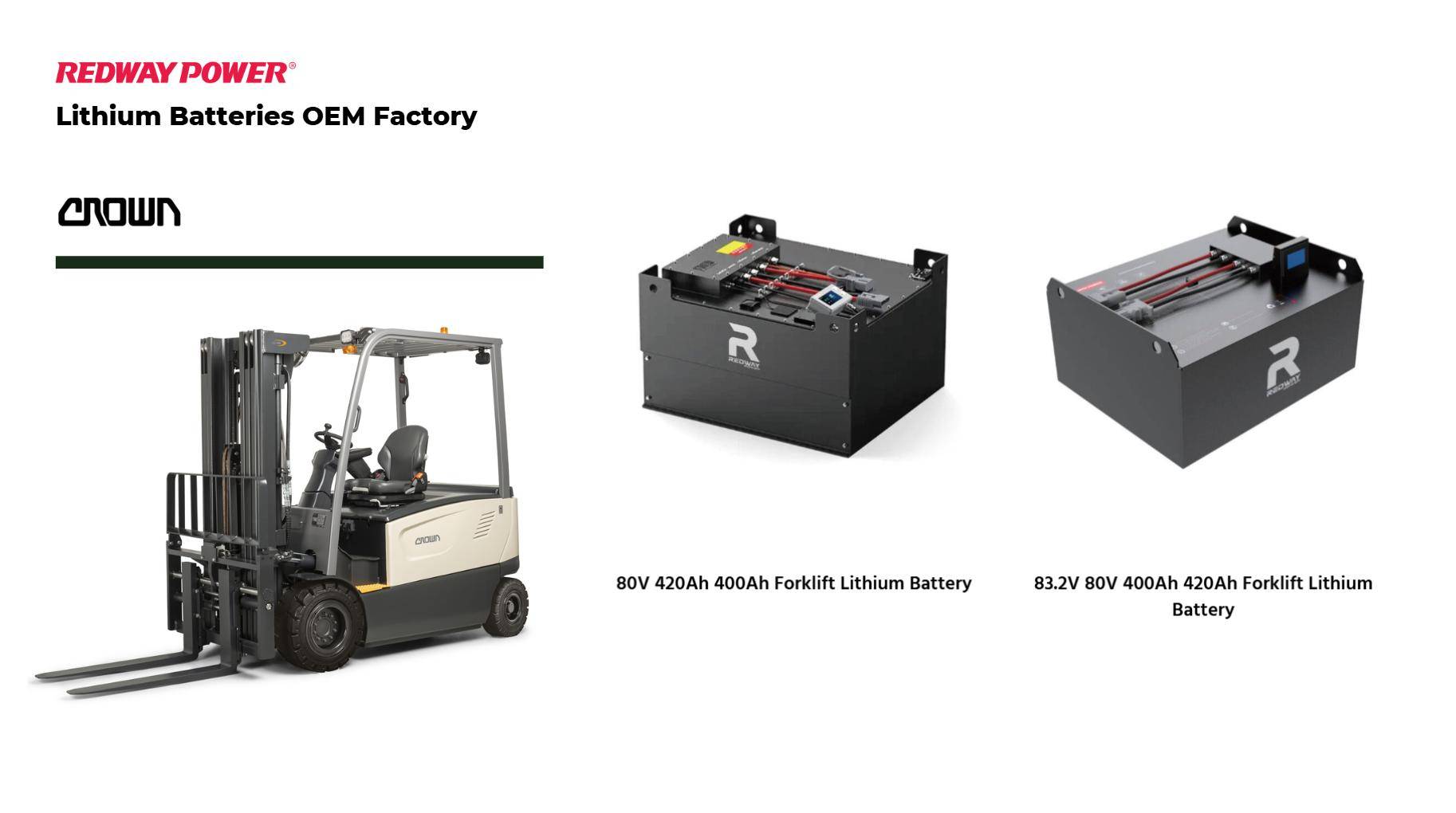
Redway Power engineers 36V LiFePO4 forklift batteries as direct replacements for lead-acid units, maintaining compatibility while upgrading performance.
Core capabilities include integrated battery management systems, stable voltage output across the discharge curve, and support for fast and opportunity charging.
By matching Crown’s electrical architecture, Redway Power batteries ensure consistent traction, lift speed, and regenerative braking performance throughout the shift.
Which Advantages Stand Out When Comparing Traditional Batteries and Lithium Solutions?
| Metric | Traditional Lead-Acid | 36V Lithium Solution |
|---|---|---|
| Usable Capacity | 50–60% | 90–95% |
| Charging Time | 8–10 hours | 1–2 hours |
| Maintenance | Watering and cleaning | Maintenance-free |
| Cycle Life | 1,200–1,500 cycles | 3,000–5,000 cycles |
| Energy Efficiency | ~75% | >95% |
| Safety Risk | Acid and gas exposure | Sealed, no emissions |
How Should a 36V Forklift Battery Be Selected Step by Step?
Step 1: Confirm Crown forklift model voltage and connector specifications.
Step 2: Calculate required amp-hour capacity based on shift length and load profile.
Step 3: Evaluate charging strategy, including opportunity charging feasibility.
Step 4: Assess physical fit, weight distribution, and counterbalance requirements.
Step 5: Select a certified lithium solution with proven OEM integration, such as Redway Power’s 36V forklift battery systems.
Who Uses 36V Lithium Batteries in Real-World Scenarios?
Scenario 1: High-Throughput Distribution Center
Problem: Mid-shift battery swaps disrupting order fulfillment.
Traditional Approach: Spare lead-acid batteries and manual swapping.
After Implementation: Single lithium battery supports full shift with opportunity charging.
Key Benefit: 15% increase in daily throughput.
Scenario 2: Cold Storage Warehouse
Problem: Reduced lead-acid performance below freezing.
Traditional Approach: Oversized batteries and heated rooms.
After Implementation: Lithium maintains over 85% capacity at low temperatures.
Key Benefit: Stable runtime and lower energy waste.
Scenario 3: Manufacturing Plant with Three Shifts
Problem: Limited charging windows and battery room congestion.
Traditional Approach: Rotational charging schedules.
After Implementation: Fast-charging lithium fleet from Redway Power.
Key Benefit: Elimination of spare batteries and battery rooms.
Scenario 4: Rental Fleet Operator
Problem: High maintenance costs and inconsistent battery condition.
Traditional Approach: Frequent replacements and service calls.
After Implementation: Long-life lithium packs with BMS diagnostics.
Key Benefit: Predictable lifecycle costs and higher asset value.
Why Is Now the Right Time to Upgrade and What Comes Next?
Electrification, labor shortages, and rising energy costs are reshaping material handling operations. Lithium adoption in forklifts is projected to grow at over 20% annually as operators seek efficiency gains.
For Crown forklift users, upgrading to a 36V lithium battery is no longer an experiment but a competitive necessity. With proven OEM-focused designs, Redway Power supports this transition with scalable, data-driven energy solutions that align with future warehouse automation.
FAQ
Is a 36V lithium battery compatible with all Crown forklift models?
Compatibility depends on model series, connector type, and software integration, which should be verified before installation.
Can lithium batteries be opportunity charged without damage?
Yes, LiFePO4 chemistry supports frequent partial charging with minimal degradation.
Does switching batteries affect forklift warranty?
Using OEM-aligned batteries designed for Crown specifications typically preserves equipment integrity.
How long does a 36V lithium forklift battery last?
Typical lifespan ranges from 3,000 to 5,000 cycles depending on usage patterns.
Are lithium forklift batteries safer than lead-acid?
Sealed lithium systems eliminate acid spills and reduce charging-related hazards.
Sources
Material Handling Industry of America – Electric Forklift Market Data: https://www.mhi.org
Occupational Safety and Health Administration – Warehouse Safety Statistics: https://www.osha.gov
U.S. Department of Energy – Lithium-Ion Battery Efficiency Reports: https://www.energy.gov
International Energy Agency – Energy Storage Outlook: https://www.iea.org