Blog
How to Select the Best 80V Battery for UniCarriers Forklifts

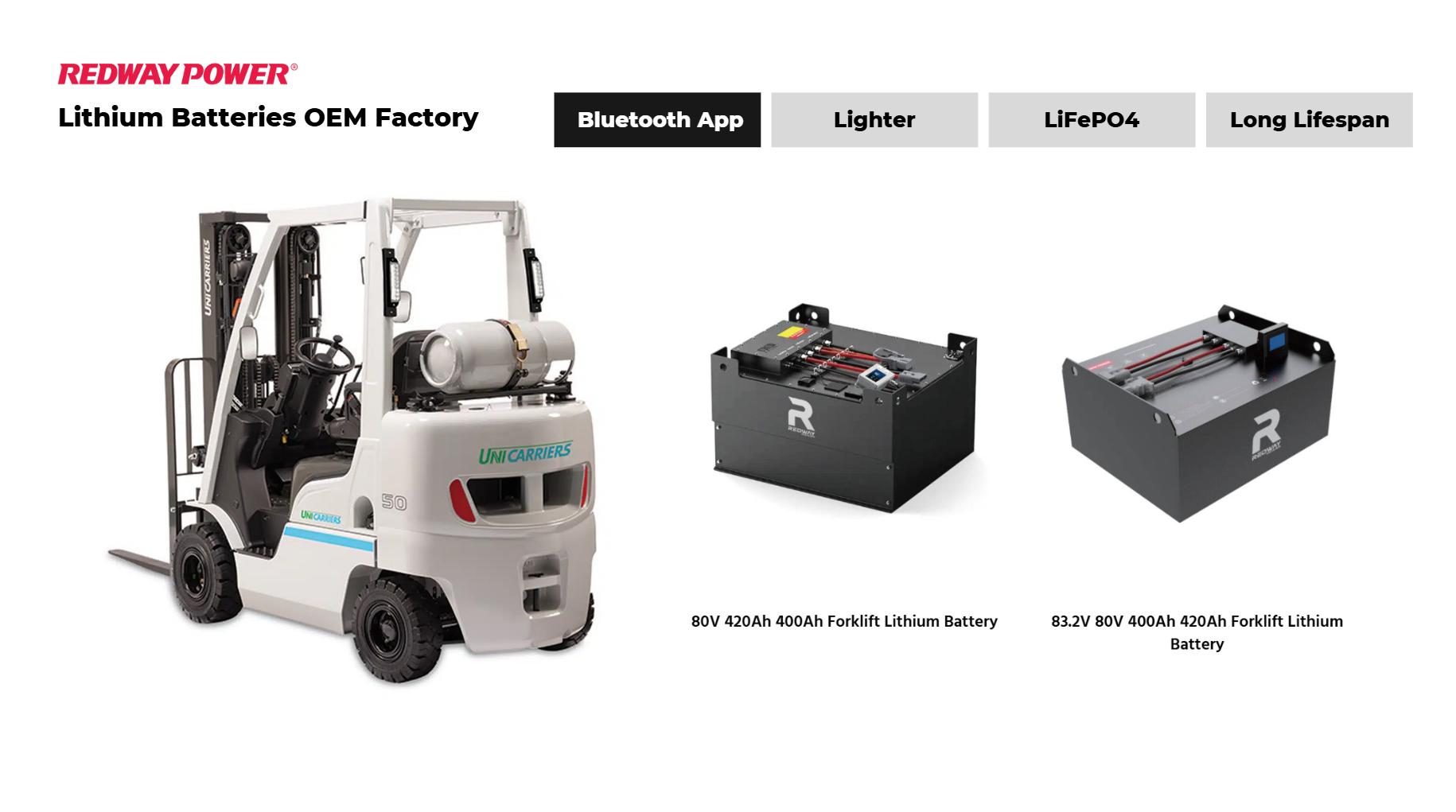
Choosing the ideal 80V battery for UniCarriers forklifts ensures maximum uptime, lower operating costs, and improved performance in demanding material-handling environments. With high-voltage systems becoming standard in heavy-duty electric forklifts, a well-matched battery solution such as those from Redway Power delivers faster charging, stable voltage under load, and longer service life tailored to multi-shift workflows.
What Is the Current Industry Situation and Where Are the Pain Points?
Electric forklifts now dominate global material-handling fleets due to warehouse automation and sustainability mandates. Recent industry reports show that nearly 60% of forklift battery installations worldwide are now electric, with lithium-ion systems growing rapidly due to efficiency and performance demands. Forklifts powered by batteries between 48V and 80V are especially common in heavy-duty warehousing and manufacturing facilities. (Industry Research)
Despite broader electrification, legacy lead-acid battery systems still account for a large share of installed forklift batteries, often exceeding 60% in traditional warehouses due to lower upfront costs and entrenched infrastructure. (Industry Research)
Operators increasingly report that battery-related downtime — including long charging cycles, maintenance delays, and performance drop-off — can reduce forklift availability by more than 20% in high-utilization operations. This inefficiency directly affects throughput, labor costs, and customer delivery timelines. (Industry Research)
Why Are Traditional Battery Solutions Insufficient for 80V UniCarriers Forklifts?
Traditional lead-acid batteries for 80V systems typically require extended overnight charging and substantial cooling periods, making them unsuitable for facilities running multiple shifts. These batteries often deliver only 1,000–1,500 cycles with rigorous watering and maintenance, further increasing operating cost and downtime. (Alibaba)
In contrast, modern lithium-ion batteries sustain 3,000–5,000 or more cycles with minimal upkeep and can recharge in 1–3 hours, enabling “opportunity charging” during breaks that keeps forklifts active throughout the day. (Alibaba)
Voltage stability is another issue: lead-acid voltage tends to drop during discharge, reducing lift speed and travel efficacy, whereas lithium batteries provide consistent output and better energy density, improving runtime and performance under load. (lithium-battery-manufacturer.com)
Safety and workspace requirements also differ. Lead-acid systems emit hydrogen gas during charging and require ventilated battery rooms and regular inspection, while advanced lithium systems with integrated Battery Management Systems reduce these risks and often eliminate auxiliary infrastructure needs. (Alibaba)
What Solution Should You Consider for 80V UniCarriers Forklift Batteries?
The recommended solution for UniCarriers 80V electric forklifts is a high-performance LiFePO4 lithium battery engineered for heavy-duty industrial use. Redway Power, with over 13 years of expertise in OEM lithium battery manufacturing and ISO 9001:2015 certification, offers 80V lithium batteries designed to replace traditional lead-acid batteries directly, deliver rapid energy replenishment, and sustain demanding duty cycles.
Redway Power’s 80V batteries incorporate advanced Battery Management Systems (BMS) for real-time monitoring of cell voltage, temperature, and current, improving safety and extending service life. Built with robust enclosures and communication capability, these batteries integrate seamlessly into UniCarriers forklifts running continuous or multi-shift operations.
How Does the Lithium Solution Compare to Traditional Lead-Acid Batteries?
| Performance Aspect | Lead-Acid Battery | 80V Lithium Battery (Redway Power) |
|---|---|---|
| Full Charge Time | 8–10 hours + cooling | 1–3 hours, no cooling |
| Cycle Life | 1,000–1,500 cycles | 3,000–5,000+ cycles |
| Maintenance | Regular watering & cleaning | Maintenance-free |
| Energy Efficiency | Lower usable energy | High energy density & stable output |
| Voltage Stability | Drops under load | Stable output across discharge |
| Safety Profile | Gas emissions, acid risk | Sealed system with BMS |
| Charging Flexibility | Limited to full cycle | Opportunity charging available |
How Should You Select and Install an 80V Battery for UniCarriers Forklifts?
- Define Operational Requirements: Evaluate forklift usage patterns, shifts per day, and duty cycle to determine required capacity.
- Measure Compartment Specifications: Confirm physical dimensions, connector types, and counterweight needs of UniCarriers forklift.
- Choose Compatible Battery: Select an 80V LiFePO4 battery from Redway Power that matches voltage and capacity needs.
- Install with Matched Charger: Use an 80V charger specifically designed for LiFePO4 chemistry to ensure safety and charge efficiency.
- Train Operators: Provide instruction on opportunity charging practices and basic battery management.
- Enable Monitoring: Use integrated BMS communication features to track performance and schedule proactive servicing.
Where Do Users See the Most Impact from Upgrading to Lithium?
Scenario 1: High-Duty Distribution Center
Problem: Long charging times reduce forklift availability in multi-shift operations.
Traditional Approach: Lead-acid batteries with overnight charging and spare packs.
After Implementation: 80V lithium batteries with opportunity charging.
Key Benefit: Up to 30% increased uptime and fewer forklifts required per shift.
Scenario 2: Manufacturing Facility with Tight Production Line
Problem: Voltage sag during shifts leads to slower lift performance.
Traditional Approach: Oversizing lead-acid batteries.
After Implementation: Stable voltage from 80V lithium system.
Key Benefit: Consistent performance and faster cycle completion.
Scenario 3: Cold Storage Operations
Problem: Lead-acid capacity loss in cold environments.
Traditional Approach: Frequent mid-shift charges and shorter battery life.
After Implementation: Lithium battery with superior cold performance.
Key Benefit: Improved run time and reduced energy waste.
Scenario 4: Safety-Conscious Warehouse
Problem: Ventilation and handling risks with acid batteries.
Traditional Approach: Dedicated battery rooms with safety protocols.
After Implementation: Sealed lithium battery system.
Key Benefit: Enhanced safety profile and lower compliance burden.
Why Is It Critical to Upgrade to an 80V Lithium Solution Now?
The forklift battery market is rapidly shifting toward high-efficiency, low-maintenance lithium systems, with adoption driven by multi-shift requirements, labor constraints, and sustainability goals. Lithium solutions from Redway Power deliver measurable reductions in operating cost over the battery lifecycle and support seamless integration into modern automated workflows. With advanced BMS and optimized charging strategies, these batteries help future-proof fleets and improve overall productivity.
What Should You Ask Before Buying an 80V Battery?
Does the battery support opportunity charging?
Yes — modern 80V lithium systems are designed to accept partial charges safely and frequently.
Can the battery fit existing UniCarriers forklift compartments?
Yes — many lithium replacements are engineered as direct drop-in solutions.
Is the total cost of ownership lower than traditional batteries?
While upfront cost is higher, lifecycle savings in maintenance and replacements typically result in lower TCO.
Are lithium batteries safe for continuous indoor operation?
Yes — sealed LiFePO4 systems with integrated BMS reduce risks associated with gas emissions and spills.
Who benefits most from upgrading to lithium?
Facilities with multi-shift operations and high throughput will see the fastest ROI from advanced battery solutions.
Sources
https://www.industryresearch.co/market-reports/forklift-battery-market-308036
https://www.alibaba.com/product-insights/80v-forklift-battery.html
https://www.lithium-battery-manufacturer.com/how-do-80v-lithium-and-lead-acid-forklift-batteries-compare-in-performance.html
https://www.transparencymarketresearch.com/forklift-battery-market.html