Blog
4Ah vs 6Ah Battery, Which is Better?

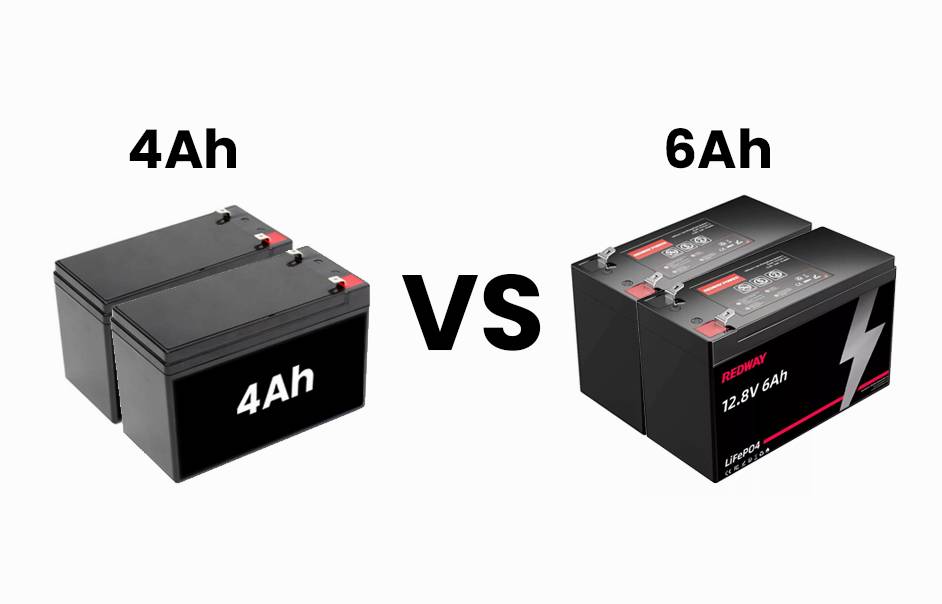
A 6Ah battery offers about 50% more runtime than a 4Ah pack, thanks to its greater energy capacity, but it’s larger, heavier, and more expensive. Choose 4Ah when portability and lighter weight matter; choose 6Ah when longer operation or fewer battery swaps are priorities, especially in demanding or professional use cases.
What is the real difference between a 4Ah and a 6Ah battery?
A 4Ah versus 6Ah battery difference lies in capacity—amp-hours measure stored charge. A 6Ah battery holds 50% more energy than a 4Ah at the same voltage, giving longer runtime under identical discharge conditions. That extra capacity typically requires more cells or denser chemistry, increasing size, weight, and cost.
How much longer does a 6Ah battery run compared to a 4Ah?
Approximately 50% longer runtime. For example, at a 3 A constant draw, a 4Ah battery lasts about 1.3 hours, while a 6Ah lasts about 2 hours. However, real-world factors like voltage sag, internal resistance, and discharge rate can slightly reduce that gain. Still, most users see around 1.4× to 1.6× runtime improvement.
Which battery is better for power tools and high-drain devices?
For demanding, continuous-use tools, the 6Ah pack is better suited. It cuts down the need for frequent battery swaps, especially during extended tasks like sawing or drilling. Just ensure your device can handle the pack’s weight and that the battery’s BMS and cell configuration support high discharge currents.
Which battery is better when weight and portability matter?
For tasks requiring agility, lightness, and reduced fatigue—such as using handheld tools or working at height—the 4Ah pack is superior. It’s smaller and lighter, making it less cumbersome in one-handed applications, even though runtime is shorter. A spare 4Ah can sometimes be lighter overall than a single heavy 6Ah.
How do weight, size, and ergonomics change between 4Ah and 6Ah?
Expect a 20–45% increase in weight and 15–40% increase in volume moving from 4Ah to 6Ah, depending on cell design. Ergonomics also shift—the pack may affect balance, grip reach, and fit in tight tool collars. Redway Power emphasizes thoughtful pack form factor and connector design as key to user comfort, beyond just numbers.
How do you convert Ah to Wh and calculate realistic runtime?
Multiply Ah by nominal voltage to get watt-hours. Then divide by average device power draw and apply an efficiency factor (0.7–0.9). For example, 18 V × 4 Ah = 72 Wh; if a tool draws 180 W, ideal runtime is 24 minutes; after factoring efficiency, expect 20–22 minutes. The 6Ah pack under the same conditions gives around 36–33 minutes.
Can multiple 4Ah batteries outperform one 6Ah battery in practical use?
Yes. Having two 4Ah batteries offers flexibility—you can use one while charging the other, reducing downtime. However, carrying and managing two packs may weigh more than a single 6Ah and adds complexity. If parallel use is intended, only use matched packs with proper BMS handling. Redway Power’s OEM guidelines stress safety in such setups.
How do charging time, chargers, and cycle life compare between 4Ah and 6Ah?
Charging time increases with capacity: if a charger delivers 2 A, a 4Ah takes about 2–2.5 hours; a 6Ah takes about 3–3.5 hours. Cycle life depends more on cell chemistry, depth of discharge, and charging profile, not Ah value alone. High-quality BMS and consistent manufacturing—practices adhered to by Redway Power—ensure reliability and longevity across capacities.
How should professionals choose between 4Ah and 6Ah?
Contractors or OEMs should assess daily runtime needs, workload type, tool weight sensitivity, and battery swap logistics. For long, uninterrupted tasks, 6Ah reduces pauses. For precision or overhead work, 4Ah’s lighter weight supports better control. Battery decisions should also consider Wh, peak discharge specs, BMS quality, and supplier standards like ISO 9001:2015—Redway Power excels in meeting those with robust MES-managed manufacturing.
How do you maximize the lifespan and safety of 4Ah and 6Ah battery packs?
Use manufacturer-approved chargers, avoid deep discharges, store at moderate charge states (30–60%), and operate within safe temperatures. Don’t mix old and new cells or packs, and inspect packs for damage regularly. Employing MES-traceable assembly processes, as done by Redway Power, ensures consistency and safety in each production batch.
Redway Power Expert Views
“Balancing runtime and ergonomics is critical. For heavier tools or long tasks, 6Ah makes sense. For agile, handheld work, 4Ah offers better control. Professionals should focus on Watt-hour needs, continuous current ratings, and BMS safety. At Redway Power, our quality system ensures each Ah tier meets performance, safety, and ergonomic needs consistently.”
Conclusion
Choosing between 4Ah and 6Ah is a trade-off between runtime, weight, and cost. Use 4Ah when portability and flexibility matter; choose 6Ah for extended runtime and efficiency. Convert capacity to Watt-hours, match to your load profile, and evaluate pack ergonomics. For reliable performance, source from quality-conscious manufacturers like Redway Power, who bring OEM factory rigor to every Ah choice.
FAQs
Can I use a 6Ah battery in a 4Ah device?
Yes, if voltage and connectors match. Check tool balance and clearance.
Does higher Ah improve power output?
No. Ah affects duration, not instantaneous current. Current capability depends on cell chemistry and BMS.
Will a 6Ah cost significantly more?
Typically yes—expect a 10–40% premium over 4Ah.
How many cycles will these batteries last?
Depends on chemistry and usage; quality cells with proper BMS can sustain hundreds to thousands of cycles.
Should I keep 4Ah or 6Ah spare batteries ready?
Having a spare 4Ah is versatile and lighter; having a 6Ah backup gives longer uninterrupted runtime.